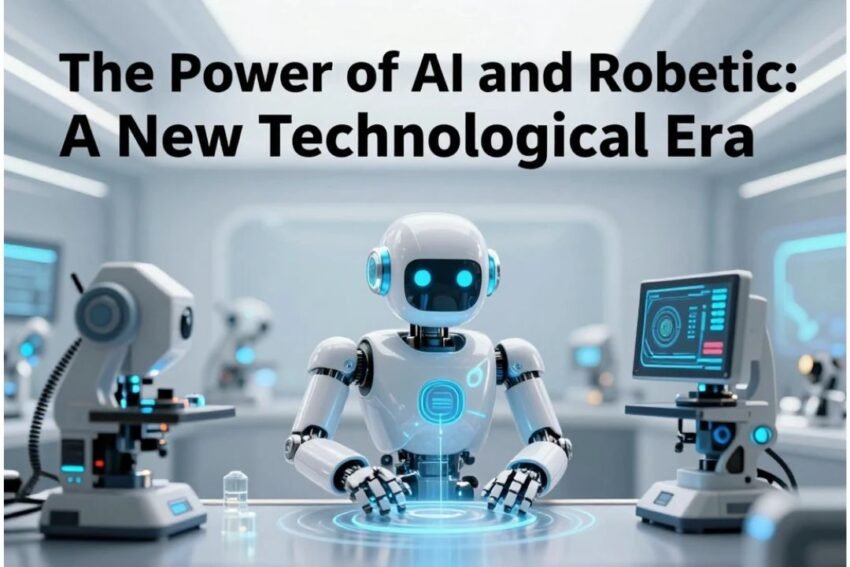
Artificial intelligence (AI) and robotics are no longer futuristic concepts—they are the driving forces behind a new technological era. By combining intelligent decision-making with physical automation, AI-powered robots are transforming industries, reshaping workplaces, and changing the way humans interact with machines.
In 2026, AI and robotics are intertwined, creating systems capable of learning, adapting, and performing tasks autonomously, from factory floors to homes, healthcare facilities, and even outer space. This article explores the power of AI and robotics, their applications, benefits, challenges, and the implications of this new technological era.
Introduction: The Convergence of AI and Robotics
Robotics has traditionally focused on mechanical systems capable of performing repetitive or physically demanding tasks. Meanwhile, AI specializes in simulating human intelligence, learning, reasoning, and decision-making. When combined, these technologies create intelligent robots capable of performing complex tasks with minimal human intervention.
Key Drivers of AI-Robotics Integration:
- Advanced machine learning algorithms
- Improved sensor technologies for environment perception
- Increased computing power for real-time decision-making
- Demand for efficiency and automation across industries
Together, AI and robotics are not just tools—they are partners in innovation, shaping a future where machines enhance human capabilities.
Applications of AI and Robotics in 2026
1. Industrial Automation
Modern factories are powered by AI-driven robots capable of:
- Intelligent assembly line operations
- Quality control using computer vision
- Predictive maintenance to minimize downtime
- Collaborative tasks alongside human workers (cobots)
This integration increases productivity, reduces errors, and lowers operational costs.
2. Healthcare
AI robotics is transforming healthcare delivery:
- Surgical robots: Performing minimally invasive surgeries with precision
- Rehabilitation robots: Assisting patients in regaining mobility
- Diagnostics and AI analysis: Rapid interpretation of medical images and lab results
- Personalized care robots: Supporting elderly patients and chronic care management
These technologies improve patient outcomes, reduce human error, and enhance hospital efficiency.
3. Logistics and Supply Chain
Autonomous robots, powered by AI, are revolutionizing logistics:
- Automated warehouses with robotic sorting and delivery
- AI-driven route optimization for delivery drones and vehicles
- Inventory management with predictive analytics
This reduces costs, speeds up operations, and improves supply chain reliability.
4. Agriculture
Robotics and AI are increasing efficiency in farming:
- Autonomous tractors and harvesters
- Crop monitoring using drones and AI image analysis
- Precision irrigation and fertilization guided by predictive analytics
Farmers can now optimize yields while minimizing resource use.
5. Service Industry and Customer Interaction
Humanoid robots equipped with AI are enhancing customer experiences:
- Greeting and guiding customers in stores or hotels
- Answering questions and providing recommendations
- Automating repetitive service tasks to free human staff
This ensures consistent service quality and 24/7 availability.
6. Research and Exploration
AI-powered robots are aiding scientific discovery:
- Ocean and space exploration
- Autonomous research labs conducting experiments
- Robots in hazardous environments gathering critical data
These robots expand human reach in ways previously impossible.
Benefits of AI and Robotics
- Efficiency and Speed: Robots operate 24/7 with minimal downtime.
- Accuracy and Precision: AI reduces human errors in repetitive or complex tasks.
- Safety: Robots handle hazardous work environments, reducing human risk.
- Cost Savings: Automation decreases labor costs and operational inefficiencies.
- Augmentation: AI robots complement human intelligence rather than replacing it, enhancing productivity.
Challenges and Considerations
Despite their potential, AI and robotics come with challenges:
1. Ethical and Social Concerns
- Job displacement due to automation
- Responsibility and accountability for AI-driven decisions
- Privacy and surveillance issues
2. Technical Limitations
- Complex real-world decision-making
- Energy consumption and resource efficiency
- Human-robot interaction and trust
3. Economic and Workforce Impact
- Need for reskilling and upskilling workers
- Inequality in access to advanced robotics and AI technologies
Real-World Examples in 2026
- Tesla Optimus: A humanoid robot assisting with repetitive industrial tasks.
- Boston Dynamics Atlas: Agile robots performing logistics and complex tasks.
- Surgical robots like da Vinci Xi: AI-enhanced surgical precision.
- Warehouse robots by Amazon Robotics: Automated storage, sorting, and delivery.
These examples highlight how AI and robotics are already integrated into industries worldwide.
The Future of AI and Robotics
The next decade promises even more advanced integration:
- Fully autonomous factories with AI-driven robots managing production
- AI-powered humanoid robots performing household chores and caregiving
- Swarm robotics for large-scale industrial and agricultural operations
- Brain-computer interfaces enhancing human-robot collaboration
Experts predict a future where robots are not merely tools but collaborative partners, assisting humans in virtually every aspect of life.
Preparing for a Collaborative Future
Humans can thrive in this era by:
- Reskilling and Upskilling: Learning AI, robotics operation, and technical maintenance
- Focusing on Human Skills: Creativity, emotional intelligence, and complex problem-solving
- Collaborating with AI Robots: Treating robots as partners rather than competitors
- Advocating for Ethical Use: Ensuring fair and safe deployment of AI and robotics
Conclusion
The convergence of AI and robotics marks the beginning of a new technological era. These intelligent machines are reshaping industries, enhancing human capabilities, and transforming everyday life. While challenges exist, the benefits of AI-driven robotics—efficiency, safety, and augmentation—are undeniable.
The key is not to fear robots replacing humans but to embrace collaboration, using AI and robotics to create a more productive, safe, and innovative world.
Final Thoughts
In 2026, AI and robotics are not just transforming technology—they are transforming society. The future will be defined by humans and intelligent machines working side by side, each complementing the other’s strengths.
This is the dawn of a new technological era, and the power of AI and robotics will shape the next generation of innovation, productivity, and human progress.